
Fragrance Guide
What Is Attar? The Complete Guide to Pakistan's Alcohol-Free Fragrance Oils
What is attar, and how is it different from perfume? A complete guide to the alcohol-free fragrance oil tradition still worn every day across Pakistan — how it's made, what attar concentration really means, and which notes to start with.
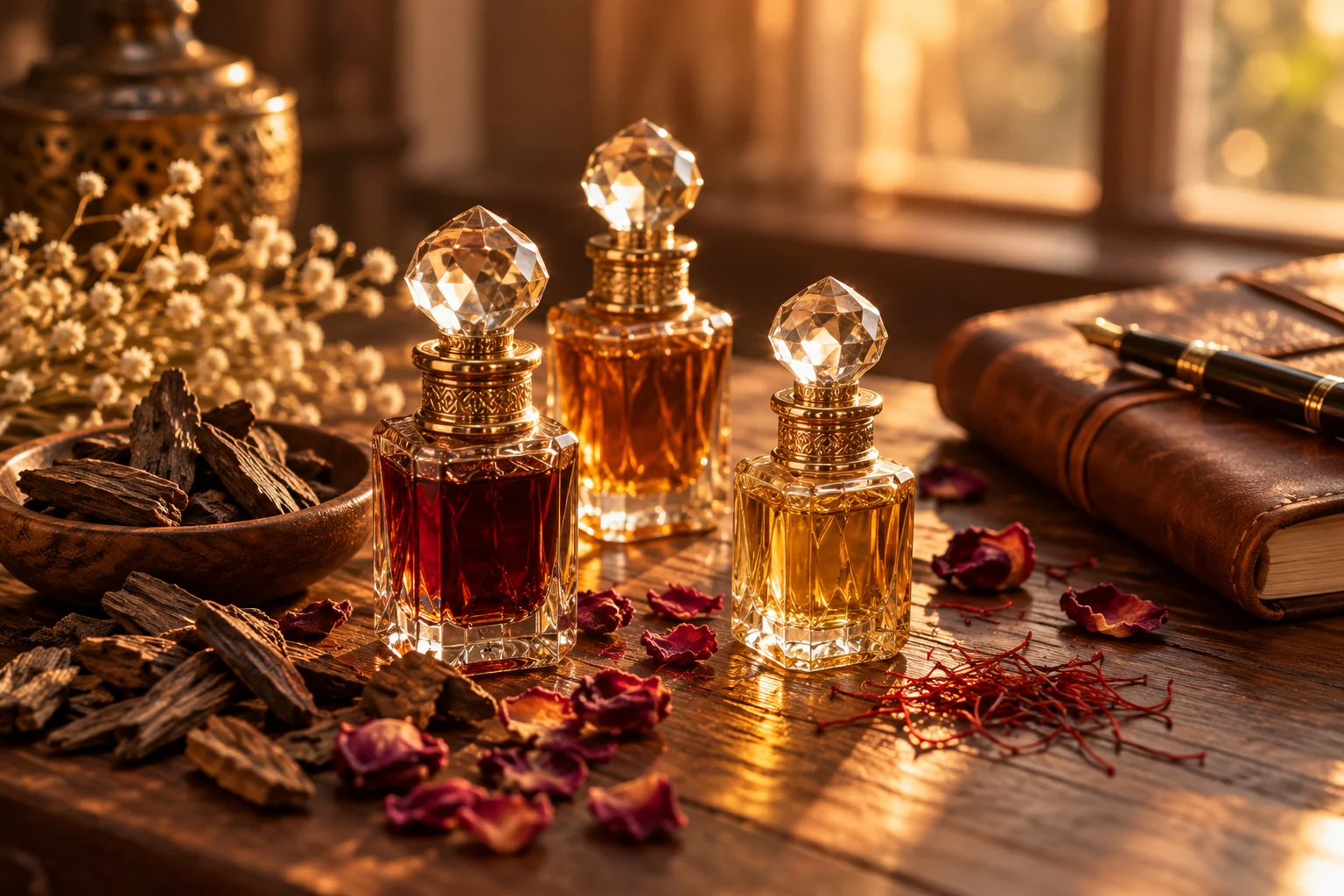
Long before the first alcohol-based perfume was ever bottled, there was attar — pure fragrance oil, distilled by hand, worn for centuries across the subcontinent and the Arab world. If you grew up around a grandmother's dressing table in Lahore or Karachi, you've probably smelled one without knowing its name: that deep, skin-warm scent that lingers for a whole day off a single dab on the wrist.
Attar is having a real moment again — not as a nostalgic throwback, but as a genuine alternative to spray perfume for anyone who wants something more concentrated, more alcohol-free, and more personal. This guide covers exactly what attar is, how it's actually made, how it's different from the EDP/EDT you already know, and how to pick your first bottle.
🌿 WHAT IS ATTAR, EXACTLY?
Attar (also spelled ittar or itr) is a pure fragrance oil — never mixed with alcohol, never diluted the way a spray perfume is. It's one of the oldest forms of perfumery in the world, with roots in the Mughal courts of the Indian subcontinent and the perfume houses of the Arabian Peninsula, long before "Eau de Parfum" was ever a category.
Where a modern EDP is mostly alcohol and water with a small percentage of actual fragrance oil suspended in it, attar is only the oil. Nothing to evaporate, nothing to dilute the scent as it dries down — just the raw material sitting on your skin, warming and evolving with your own body heat over hours.
⚗️ HOW IS ATTAR MADE? (THE REAL ANSWER TO "ATTAR CONCENTRATION")
This is the part most people never actually get told, and it's the whole reason attar smells and behaves so differently from a spray. Traditional attar is made using deg-bhapka hydro-distillation — flowers, wood, roots, or resins are placed in a copper still (the deg) with water, heated slowly over an open flame, and the resulting steam is condensed directly into a receiving vessel (the bhapka) that's already sitting in a base oil, traditionally sandalwood.
The vapor carries the raw material's aromatic compounds straight into that oil, drop by drop, over hours of slow distillation. What comes out the other end isn't a "fragrance" in the perfumery-lab sense — it's closer to an infusion, the same aromatic compounds you'd find in the plant or wood itself, just concentrated into oil form.
That's still only half the process. A freshly distilled attar is harsh and unbalanced — it needs to rest. Every attar in our own collection is naturally macerated in its sandalwood base for a minimum of 45 days, and some (like our Shamama Gold Attar, a complex layered blend of cinnamon, hay-sweet accords and green notes) are aged for 90+ days before they're considered finished. That maceration period is what turns a raw distillate into something that actually smells complete — the notes marry, the sharp edges soften, and the scent becomes something closer to a single, unified accord than a list of ingredients.
💧 ATTAR VS PERFUME: WHAT ACTUALLY CHANGES
| Factor | Attar | EDP / EDT Spray |
|---|---|---|
| Base | Pure oil, no alcohol | Alcohol + water, small % oil |
| Application | Dab/roll on pulse points | Spray, 2-4ft from skin |
| Longevity | Often 12+ hours, warms with skin | 4-8 hours typically |
| Sillage | Close, intimate, skin scent | Wider projection |
| Alcohol-free | Yes | No |
Neither is "better" — they're built for different things. A spray perfume is designed to project outward and announce itself the moment you walk into a room. Attar is designed to live on your skin, close and warm, discovered by anyone who gets near you rather than broadcast to the whole room. That's also exactly why attar has stayed so central to how fragrance is worn in Pakistan: it's alcohol-free (a real, practical reason many people prefer it, not just a cultural footnote), it survives long hours in the heat without burning off, and a single small bottle genuinely lasts for months of daily wear.
🕌 WHY ATTAR STILL MATTERS IN PAKISTAN TODAY
Attar isn't a museum piece here — it's in daily rotation for millions of people, and for real, practical reasons. Being alcohol-free means it's the fragrance of choice before prayer, in mosques, and through Ramadan and Eid, when many people specifically look for exactly this kind of scent. It's also simply built for the climate: an alcohol-based spray can feel thin and short-lived in Lahore's summer heat, while a well-made attar keeps developing on skin for the whole day.
There's a gifting tradition here too — a beautifully bottled attar, handed over in a small ornate vial, has always read as a more personal, more considered gift than a mass-market spray bottle. If you're picking something for Eid or a wedding, that's worth keeping in mind.
🌸 THE BUILDING-BLOCK NOTES OF ATTAR, EXPLAINED
Attar is built from a smaller, more traditional palette than modern perfumery — but each of these raw materials has its own real story.
Oud (Agarwood)
Oud is resin-infused agarwood — the tree itself doesn't normally smell like anything; the scent only develops after the wood is infected by a specific mould and produces a dark, fragrant resin in self-defense. That resin is what gets distilled. It's smoky, deep, and slightly animalic, and it's the backbone of countless attars — including our own Oud al Malak Attar, which pairs it with amber, cedarwood and cinnamon for a warm, velvety result that settles on skin like a cloak in candlelight.
Musk
Modern musk is entirely synthetic (the original animal-derived version has been off the market for ethical and legal reasons for decades), but it still does the same job it always has: a soft, powdery, skin-like warmth that makes everything else in a blend feel closer and gentler. Our Musk-e-Laila Attar is built almost entirely around this — a fresh, powdery white musk macerated for 45 days until it reads as soft and luminous rather than sharp.
Saffron (Kesar)
Saffron in perfumery smells nothing like the spice in your kitchen — it's leathery, faintly sweet, and a little smoky, closer to worn leather with a thread of honey running through it. Two of our attars build directly on it: Kesar-e-Shab Attar pairs it with honey and leather for something that reads like the last light of a desert sunset, while Qahwa Nights Attar folds saffron in alongside coffee and cinnamon for a warmer, more gourmand take.
Rose
Rose attar (traditionally called ruh gulab when distilled on its own) is one of the oldest attars in existence — recorded in Mughal court records centuries ago. Our Ishq-e-Gulab Attar pairs rose with incense for a deeper, more contemplative version of it, rather than a simple floral.
Khas (Vetiver)
Khas is the root of a grass (vetiver), and it smells exactly like you'd expect an earthy root to smell — damp soil, green, faintly smoky. It's traditionally one of the most cooling scents in Pakistani and Indian perfumery, worn in peak summer heat for exactly that reason. Ushira-e-Khas Attar is built to capture that full, earthy depth, with green leaves and moss alongside the vetiver root itself.
Amber and Resin
Amber in perfumery is a blended accord (not literal fossilized tree resin), usually built from labdanum, vanilla and warm resins to create a sweet, glowing warmth. Amber-e-Sultan Attar leans into this fully, combining it with frankincense, cedarwood and honey for something that settles on skin like a royal seal in molten gold.
Fresh and Green
Not every attar is heavy — Bagh-e-Jannat Attar is built on a fresh accord with green leaves and musk, closer to morning dew on a rose petal than anything smoky or resinous, and macerated for a shorter 45 days to keep that lightness intact.
Unexpected and Gourmand
Attar doesn't have to mean oud and rose. Maracuja Mystique Attar pairs dark chocolate with passion fruit for something genuinely unusual in this category, while Qahwa Nights Attar's coffee-cinnamon-saffron blend reads more like a late-night gathering than a traditional attar at all.
👃 HOW TO ACTUALLY WEAR ATTAR
Less is genuinely more. Attar is far more concentrated than spray perfume — one small dab on each pulse point (wrists, behind the ears, base of the throat) is usually enough for a full day.
Apply to pulse points, not clothing. Attar develops with your body heat, so it needs skin contact to open up properly — dab it on rather than spraying it into the air.
Let it settle before judging it. Because there's no alcohol to flash off, attar can smell slightly different in the first few minutes than it does an hour later, once it's warmed against your skin.
A little bottle lasts a long time. Most of our attars come in 6ml bottles — that sounds small next to a 50ml spray bottle, but at a few drops per wear, it's genuinely months of daily use.
❓ FREQUENTLY ASKED QUESTIONS
Q: Is attar halal?
A: Yes — every attar we make is alcohol-free by definition, which is exactly why it's the preferred choice for wear before prayer and through Ramadan and Eid.
Q: Does attar last longer than perfume?
A: Generally, yes. Because it's pure oil with nothing to evaporate, attar tends to develop slowly and stay close to the skin for many hours — often a full day from a single application, versus the 4-8 hours typical of a spray EDP.
Q: Can attar be worn by both men and women?
A: Most attars are genuinely unisex — notes like oud, amber, saffron and musk don't belong to either gender. We do have a few built with a specific wearer in mind (Oud al Malak and Ushira-e-Khas for men, Musk-e-Laila and Bagh-e-Jannat for women), but the rest of the collection is designed to be worn by anyone.
Q: Is attar the same thing as oud oil?
A: Not quite — oud oil (sometimes sold on its own as "dehn al oud") is just one raw material distilled by itself. Attar is the broader category: any pure, alcohol-free fragrance oil, which may or may not contain oud alongside other materials like rose, saffron, musk or amber.
Q: How do I pick my first attar?
A: Start with what you already know you like in a spray perfume, then look for the same note here. If you gravitate toward warm, spicy fragrances, Kesar-e-Shab or Amber-e-Sultan are good starting points. If you prefer something lighter and cleaner, Musk-e-Laila or Bagh-e-Jannat are easier introductions than a heavy oud straight away.
💭 FINAL THOUGHTS
Attar isn't a trend chasing spray perfume's coattails — it's the older, more concentrated tradition that alcohol-based perfumery grew up alongside, and it's still the better choice for anyone who wants something alcohol-free, longer-lasting, and closer to the skin. Whether you're drawn to the smoky depth of oud, the leathery warmth of saffron, or the soft powder of musk, there's a real, traditionally-made attar behind each one.
Alcohol-free, hand-blended, and macerated for weeks before it ever reaches you — discover which attar becomes yours.
Continue Reading
More Articles
Fragrance Guide
Best Summer Perfumes in Pakistan 2026: A Complete Guide for Men & Women
25 September 2026
Fragrance Guide
Best Summer Perfumes in Pakistan 2026: A Complete Guide for Men & Women
Fragrance Guide
Best Perfumes for Women in Pakistan 2026: What to Wear for Office, Dates, Weddings & Everyday
25 September 2026
Fragrance Guide
Best Perfumes for Women in Pakistan 2026: What to Wear for Office, Dates, Weddings & Everyday
Fragrance Guide
Best Perfumes for Men in Pakistan 2026: What to Wear for Office, Dates, Weddings & Everyday
16 September 2026
Fragrance Guide
Best Perfumes for Men in Pakistan 2026: What to Wear for Office, Dates, Weddings & Everyday
Fragrance Guide
Best Winter Perfumes in Pakistan 2026: A Complete Guide for Men & Women
16 September 2026
Fragrance Guide